
This article originally appeared in Governing’s Inside Politics newsletter. Subscribe here to get the latest state and local politics news and analysis right in your inbox. Also in this issue: Paxton Backs Off.
Texas Republicans spent the last few years in a tense intraparty battle for the position of speaker of the state House. Around the end of 2024, former speaker Dade Phelan was edged out by fellow Republican Dustin Burrows, partly because Burrows promised to take a harder conservative line in a chamber that had been drifting to the right for years. He committed to appointing only Republicans to committee chair positions, depriving the minority party of one of its only remaining tokens of participation in the legislative process.
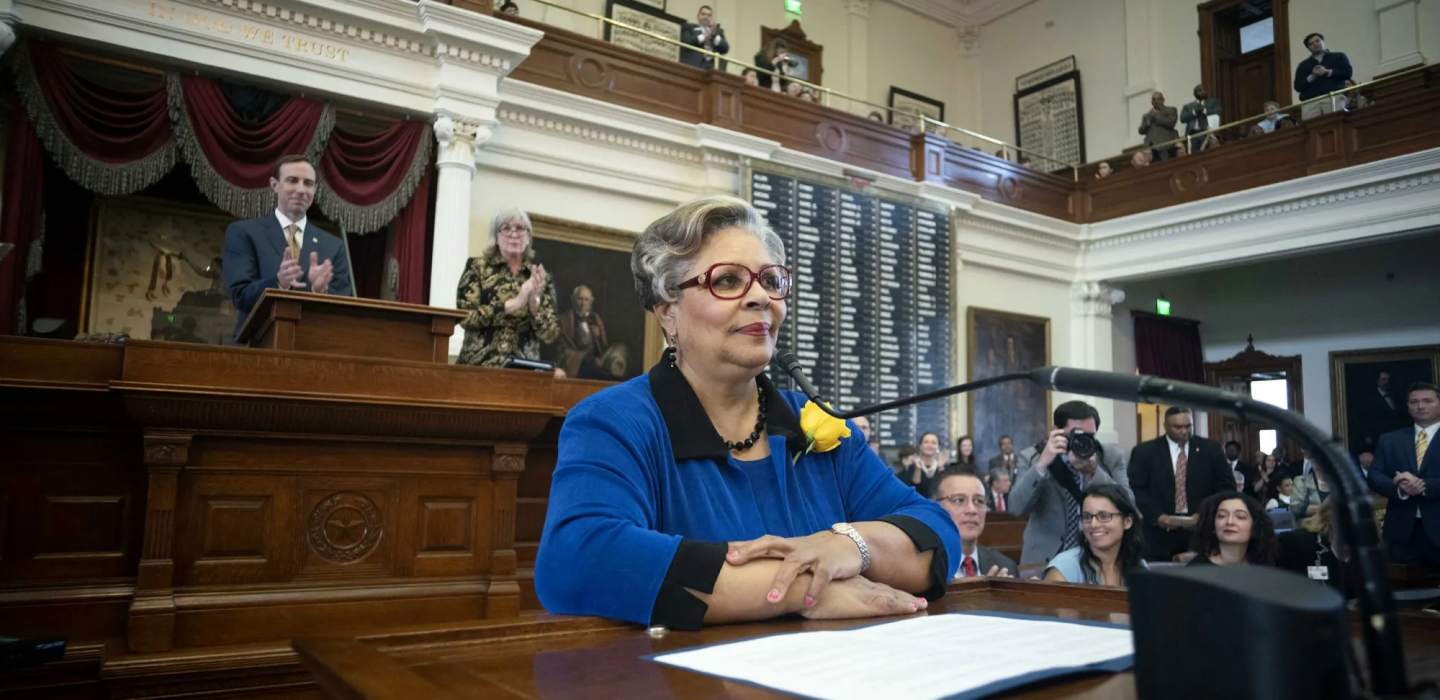
Now the minority party is back on top, and so far, it’s striking a more conciliatory tone. Democrats won their first majority in the Texas state House since 2002 and have lined up behind 87-year-old Senfronia Thompson as their next speaker. Thompson has represented the Houston area in the Texas House for more than 50 years. She’ll be the first Black woman to serve in the role. And she plans to resume the practice of appointing minority-party members as committee chairs.
“I’m not here to punish anybody,” Thompson said in a press conference after the election. “I did that when I was a parent. And all of my children are adults now.”
The number of Black female state house speakers will at least double next year, with Thompson in Texas, Jennifer Bacon in Colorado, and Carolyn Hugley in Georgia joining Joanna McClinton in Pennsylvania, Melissa Minor-Brown in Delaware, and Joseline A. Peña-Melnyk in Maryland. Women of color also lead the Hawaii state House, the California Senate and the Virginia Senate. Georgia will have the nation’s first Black woman governor in Keisha Lance Bottoms, while New Mexico Gov.-elect Deb Haaland will be the first Native American woman governor, and Gina Hinojosa will be the first Latina governor of Texas. Recent polls show women were much more likely than men to vote for Democratic candidates across contests.
Women will hold more than 2,500 state legislative seats, a record high, and about twice as many seats as they held in 1990. That’s still only hold about a third of all state legislative seats, but they will hold at least half the state legislative seats in six states. Unsurprisingly for a blue wave election, Democratic women did much better than Republican women. The ranks of Democratic women in state legislatures will grow by about 300 while state legislatures will have about 200 fewer Republican women next year.
“We’ve been seeing a gap in the numbers between Democratic and Republican women, but we’ve never seen a gap as big as the one we’re looking at in the coming cycle,” says Debbie Walsh, director of the Center for American Women and Politics at Rutgers University.
How might a growing cohort of women representatives and leaders change state legislative politics? It wouldn’t be realistic to expect them to “instantaneously transform institutions,” Walsh says. But women lawmakers often say they get into politics to solve specific problems, while men are somewhat likelier to cite an interest in politics in general, she says
“If you come into government because you want to fix something, you have to figure out ways to pull people together and work across the aisle. We may see some of that,” Walsh predicts.
Affordability was the theme of the election. And Black women in particular are more likely than most to have had personal lived experiences with financial hardship, whether they grew up with food scarcity or left college with big student loan burdens. In Georgia, Black women will hold not only the governorship and the top role in the state House next year, but almost every major state office as well. “Black women’s lived experience allowed for a connectivity to the issues,” says Tammy Greer, a Georgia State University political scientist.
Democrats in every state are under pressure to deliver affordability benefits ahead of the 2028 election, when the anti-incumbent pendulum could swing back again. Women of color face additional pressure as they anticipate racialized backlash to their leadership, akin to the rise of the Tea Party that followed the election of the first Black U.S. president. Black women’s rise in Georgia politics comes with a need to provide the solutions voters are asking for while bracing for a demographic shift in the electorate in the next cycle.
“It could easily be wiped away if they’re not repairing and preparing at the same time,” Greer says.
Paxton Backs Off
You can guess what happened in November’s election just by looking at the lawsuits that Texas Attorney General Ken Paxton has abandoned in the last week.
One suit, which Paxton had filed in February, sought to have the Council on American-Islamic Relations labeled a terrorist group that was seeking to “establish dominion through Sharia law.” Another lawsuit that Paxton had filed in 2024 charged the NCAA with deceptive practices for allowing transgender athletes to participate in events labeled “women’s sports.” He filed another pair of suits against doctors for providing gender-affirming care for minors, allegedly in violation of Texas law. He sued out-of-state doctors for providing abortion bills to Texas women. All those suits have been dismissed by his office since the election.
Paxton has been Texas attorney general since 2015. His tenure has been marked by a dogged pursuit of conservative causes, especially in relation to culture war issues that have animated much of the Republican base, like those represented in the lawsuits he recently dropped. Paxton was impeached by the Texas House for corruption, but later acquitted by the state Senate. He sought a U.S. Senate seat this year, defeating Sen. John Cornyn in the Republican primary but losing badly in the general to James Talarico, who became the first Democrat elected to the U.S. Senate from Texas since 1988.
Meanwhile, Democrat Nathan Johnson won the Texas attorney general’s post, taking the office from Republicans for the first time since the 1990s. Johnson applauded the decision to drop the lawsuits. Some former Democratic attorneys general have speculated that Paxton dropped the suits because he didn’t want their outcome to be determined by his successor.
In any event, his decision to back away from those suits represents a retreat for the conservative legal movement on divisive culture-war issues. In winning the Texas AG race, Democrats “took the head of the snake,” Sean Rankin, president of the Democratic Attorneys General Association, told Politico earlier this month. Gina Hinojosa, the Democratic Texas governor-elect, also ran a campaign that conspicuously sidestepped culture war issues. The outcome of those elections in Texas could have lasting consequences for how transgender issues, reproductive rights and other cultural questions play into political campaigns around the country.