
Lisa Desjardins:
Israel has been at war for the last three years, first attacked by Hamas in 2023, and then launching war against Iran alongside the U.S.
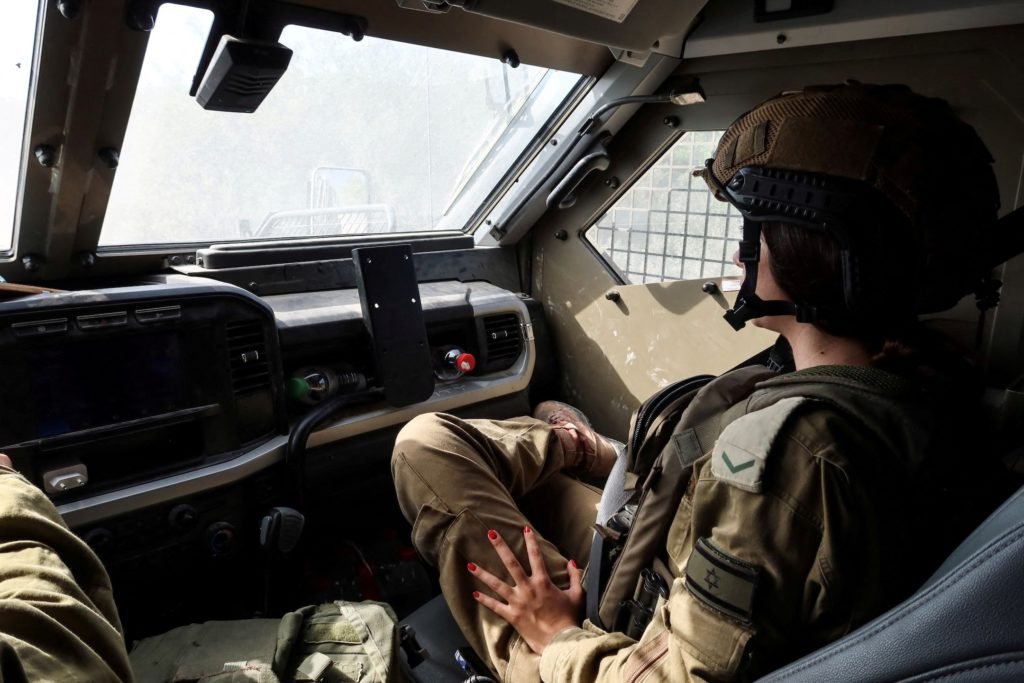
Women have long been at the forefront of the Israel Defense Forces. Now their roles are only expanding.
Special correspondent Nurit Ben looks at their service and their unique challenges.
Nurit Ben:
A missile strike in a Central Israeli city, and 40 soldiers are up against time. Today, it’s just a drill, part of a three-month command course for a rescue brigade sent to the most difficult of crisis zones in war or in natural disasters around the world.
In Israel these days, the disasters are all manmade. These scenes have played out across the country over the last year of war with Iran, like this building in Tel Aviv, the site of a direct missile hit, where PBS News was on the scene last June when the U.S. and Israel struck Iran’s nuclear sites.
Over 46 hours with little sleep, the soldiers need to save as many lives as possible, retrieving bodies intact.
Staff Sergeant H:
This specific drill, the hard thing about it is the amount of time. So it’s more hard mentally, keeping your squad motivated without water, with the heat, without sleep.
Nurit Ben:
Twenty-year-old Staff Sergeant H is one of about 30 women here in this combat unit where men and women serve together, led by a female commander. IDF regulations required we not show her face or use her name.
For her, a combat role was a clear choice.
Staff Sergeant H:
And you can get to a high ranks. You can get to a lot of places if you fight hard enough for it.
Nurit Ben:
Just a few years ago, a scenario like this one of a ballistic missile hitting a civilian center would have seemed far-fetched. But the war between Israel and Iran has made it a reality. It’s a new normal the country itself and the military is on guard for.
And, like everything else, women are a huge part of that. Just in this drill alone, some 75 percent of the soldiers are women serving right alongside men.
Staff Sergeant Y:
I guess it’s surprising because it’s very physical, so you might guess there are more men, but, actually, they’re more women. And we do exactly the same.
Nurit Ben:
Over the last decade, the number of women in combat roles has grown threefold. By now, they make up about 21 percent of the military’s combat force. New pilot programs have also opened up a path to the most elite frontline units.
That was on display here, some 20 female soldiers marking the end of a year of grueling training testing physical and mental strength.
Woman:
The most challenging and prestigious in the IDF.
Nurit Ben:
They’re now officially in the elite unit Yahalom, or Diamond. Part of the combat engineering corps, they’re the ones entering tunnels, like those Hamas has used to launch its attacks and hold hostages.
Leading them was Major G, the unit’s first ever female company commander. Frontline roles like this might be new, but women in uniform here are not. They have served in the military since its inception, mandatory service that’s also part of the cultural fabric.
Take Tova Dolev. In 1973, at age 18, she was set to start university. But, shocking her parents, she changed her mind, a decision that would end up changing her life. She was chosen for a top intelligence unit, her base at the highly strategic town of Sharm el-Sheikh in the Sinai Peninsula.
Tova Dolev (through interpreter):
My job was to identify enemy ships, aircraft, missile batteries, anything that had a radar on it. If something posed a danger, we reported it.
Nurit Ben:
On one Friday night, Tova had just finished her shift at midnight and gone to sleep. The Yom Kippur War was about to break out. Egypt and Syria launched a coordinated surprise attack against Israel on the holiest day of the Jewish calendar.
Tova Dolev (through interpreter):
Suddenly shouting, “Egyptian MiGs had entered the base.” Bombs are falling from the sky, and, like that, I ran toward the shelter that I barely even knew where it was. And everyone ran there.
Nurit Ben:
All communications with the base had been cut off. Tova was one of just two people trained to monitor radar, and was asked to step in.
Tova Dolev (through interpreter):
And I picked up on two destroyers. The moment I saw the signals, I shouted out the code words, threw off my headphones, and reported immediately to the Red Sea maritime zone. I also reported to the air force. They told me to get out immediately.
Nurit Ben:
She and eight other women began a long journey to get out.
Tova Dolev (through interpreter):
Every moment, they were telling us: “They’re about to bomb. There are planes overhead.” They tried to hide us, and everyone knew there were girls in the area.
Nurit Ben:
In the hours that followed, the women were sent off again and again to hide in nearby sand dunes, with rumors that Egyptian commandos had landed nearby, finally relief, as they were flown out to safety.
Tova Dolev (through interpreter):
We arrived at the Ben-Gurion terminal. There were masses of men who had been drafted. It was total silence. Everyone froze. They parted and let us pass through the middle. No one understood where we had come from without shoes, mud on our faces.
Nurit Ben:
The war became a national catastrophe, starting with a shocking surprise, the kind the country hadn’t seen in its young history, and not again until another early Saturday morning exactly 50 years later, October 7, 2023, a coordinated attack carried out by thousands of Hamas assailants, who flooded Israeli communities near the Gaza Strip and a local music festival filled with hundreds of young concertgoers.
Over 1,200 people were massacred and 251 taken hostage in Gaza.
Staff Sergeant S:
The entire country’s mindset shifted. There’s always some threat. October 7 reminded us how big that threat still is.
Nurit Ben:
Staff Sergeant S was in London in the middle of getting her master’s degree in neuroscience when it unfolded.
Staff Sergeant S:
I just remember thinking, I can’t sit in this room and read my books and go about London and have fun when my people are dying.
Nurit Ben:
Today, she’s a combat soldier in an air defense unit.
Staff Sergeant S:
Without the air defense force, we wouldn’t be here today, because every missile, every drone, every rocket, every UAV, it kills people.
Nurit Ben:
It’s a vital part of the country’s security, and about 50 percent of all air defense personnel are women.
Around the world, for many people of this age, 19, 20 years old, it’s a time of freedom and little responsibility. For these women, it’s a time of being pushed to the limit and often finding purpose in the process.
Staff Sergeant Y:
I think this is the best choice I could have made, because it’s challenging, and because you want to maybe prove yourself, or prove, like, other people or men that you can do something that maybe they don’t think you can do.
Tova Dolev (through interpreter):
I can tell you what I learned about myself, that I am genuinely strong and I have no fear. I’m not afraid of anything. If I want to do something, I do it. I go all the way.
Nurit Ben:
For the “PBS News Hour,” I’m Nurit Ben in Tel Aviv.